
LAPR (Laser Presbyopia Reversal)
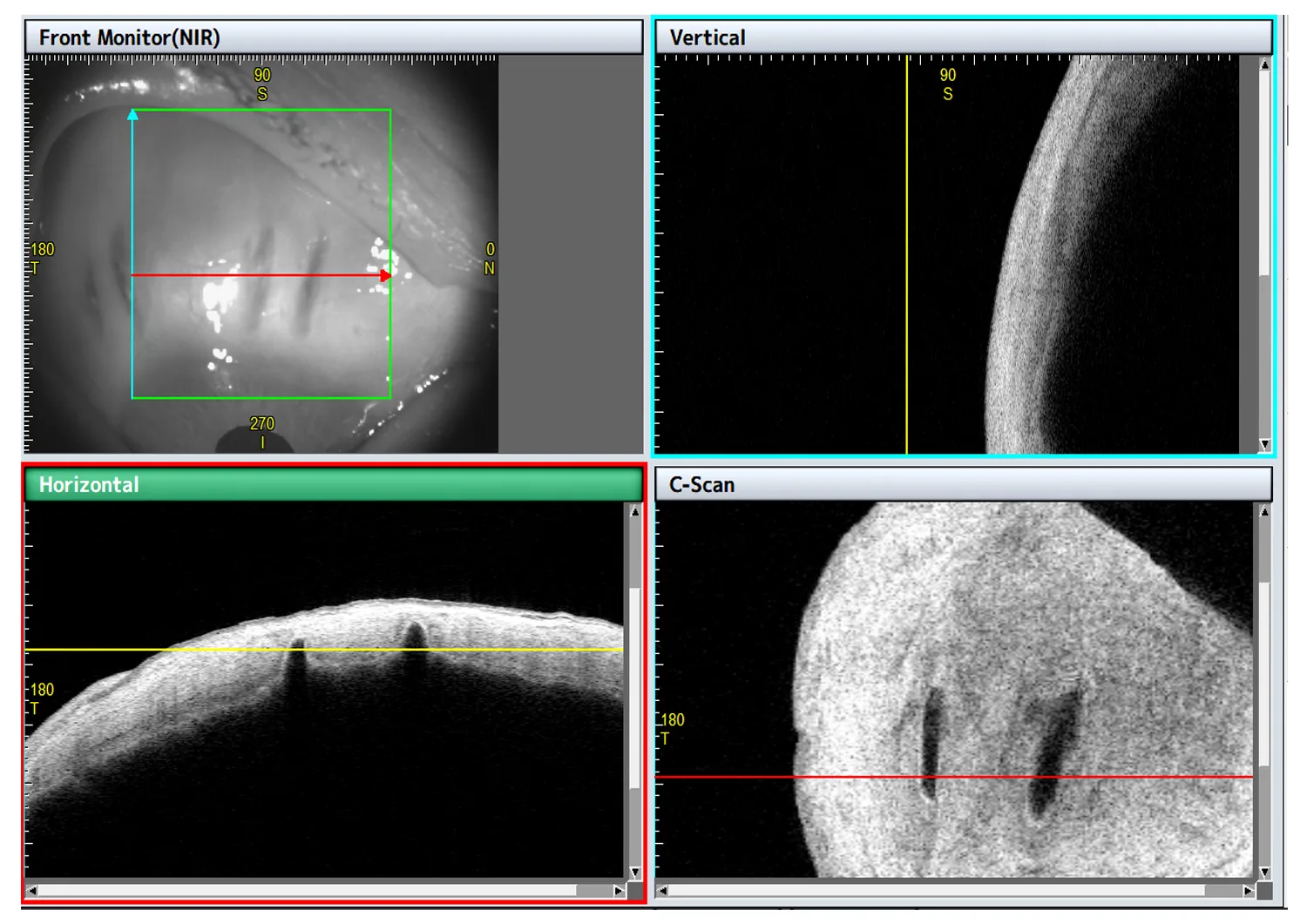
Erbium laser effects of radial cuts into the scleral tissue to reduce ocular biomechanics and rigidity to restore the accommodation in a presbyopic patient. The deepness of the scleral tissue is still visible almost 30 years after LAPR surgery. Thanks to the swept-source AS-OCT CASIA2 images, we can see that there was not a complete perforation until the blue choroid. Given that LAPR is still performed manually, complications may occur and the scars had a different deepness being done manually. This old and amazing experimental technique will soon be replaced by a new OCT and computer-guided, safer and more efficient called LSM (Laser Scleral Microporation).
From my practice – what makes CASIA2 stand out
I enjoy the CASIA2 because being a swept-source OCT you can go deeper and see better the whole anterior segment even until the posterior capsule of the lens.
This makes an easier way to stage all kinds of cataracts. The integration with the OA-2000 biometer can give an instant calculation with a lot of formulas, including also the pre- (and post-) tilting of the lens and the angle kappa which can be an inclusion or exclusion for a premium IOL. The software is always updated and you can play with the internal toric IOL calculator which includes also the posterior and total cylinder. You can also choose the right astigmatism axis from the fourier and the okulix formula which I found very effective, especially in irregular corneas (e.g. keratoconus, irregular astigmatism or post-refractive, including post-RK).
The complete corneal trend analysis also makes follow-up easier, especially in my keratoconus patients where also the epithelial map is included. With the newest software you can also follow up the narrowing of an irido-corneal angle, which can suggest or not a prevention for an acute glaucoma with a laser iridotomy or a lens replacement. My favourite software is the inclusion of the Nakamura and KS formulas which simplify the selection for a correct vaulting in posterior chamber phakic IOLs.
The CASIA2 acquisition is very quick, easy and repeatable and you can play also in 3D images and with movies which can be very useful, especially to detect the dynamic vaulting in cases where a posterior phakic IOL is with a low vaulting.
Further Questions?
Do you have any questions or require further information?
We would be pleased if you send us an inquiry.